
BioEssays – https://doi.org/10.1002/bies.70124
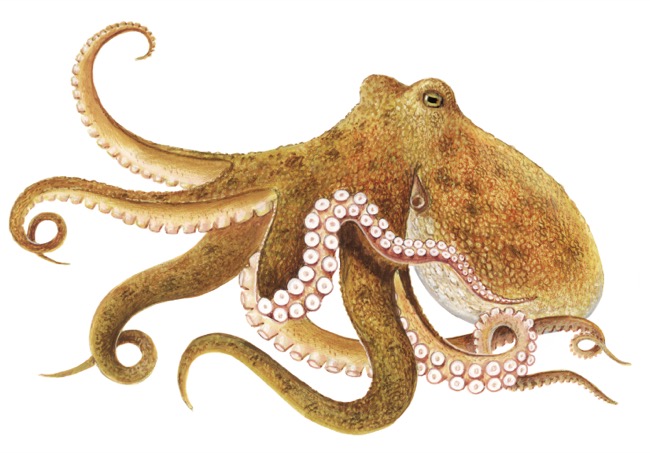
Transposable elements have been described as self-seekers of the germline, team players of the soma. So, when full-length transcripts of a LINE transposon showed up in the octopus brain, the blogosphere went wild with speculation about how this “mechanism” might have evolved for the purpose of generating variation in their brains. Since octopuses are “smart,” and since TEs are active in their brains, perhaps TEs somehow contribute to their intelligence – or so the thinking goes. In our recent paper, we question this line of reasoning. The available evidence of TE activity in octopus genome is also compatible with a Selfish DNA interpretation that attributes to no benefit to the organism. How then can this impasse be resolved? Our proposal is that a genome-ecological perspective provides a fresh perspective for interpreting TE activity in octopus brains. Think of the germline as a genomic “niche” to which certain TEs are adapted. Different tissues can be compared to according to their degrees of niche-overlap with germ cells. One would therefore predict, as a baseline scenario, that levels of TE activity across tissues correspond to their degree of niche-overlap with germ cells. This helps us understand when it is appropriate to get excited about TE activity in octopus brains: when levels of TE activity are higher than one would predict given the baseline expectation as determined by the degree of niche-overlap with germ cells.
Leave a Reply